Who picked this for you?
Instagram carousel preview (1080 × 1350)
Verified source ledger
-
On YouTube's recommendation system
Cristos Goodrow (YouTube Official Blog) — September 15, 2021
Limits: Explains the company's described recommendation signals in 2021. It is not an independent audit of every app or a claim that a feed determines a person's beliefs. The report contains the wider research and its limitations.
Instagram caption
Third-person institutional voice. Prepared draft; not posted.
Short video & voiceover teleprompter
Silent vertical Reel (~15 sec) alongside synchronized voiceover script.
Voiceover text to record
"Who brought you this story? Follow one possible route: a reporter produces it, a publisher runs it, and a platform recommends it. Different decisions shape what gets made and what reaches your feed. The Daily Nun."
On-screen kinetic text sequence
- Who brought you this story?
- A reporter produces it.
- A publisher runs it.
- A platform recommends it.
- One story. Three decisions.
- The Daily Nun / A closer look at the world.
Who is actually responsible?
Instagram carousel preview (1080 × 1350)
Verified source ledger
-
Census Bureau Releases 2022 Census of Governments: Organization Data
U.S. Census Bureau (Census Bureau press release) — August 24, 2023
Limits: Counts special districts and independent school districts as governments. It does not describe any one city's charter or who proposes its budget. -
Open Government Guide: California
Reporters Committee for Freedom of the Press (RCFP) — Checked November 15, 2026
Limits: Summarizes California's Brown Act: agenda posted at least 72 hours before a regular meeting, and public comment. A secondary summary, and California only. Notice periods differ in other states. -
Florida Statutes, section 286.011
State of Florida (Florida Senate, Online Sunshine) — 2025 statutes
Limits: Requires 'reasonable notice' of meetings and recorded minutes. It sets no fixed number of hours.
Instagram caption
Third-person institutional voice. Prepared draft; not posted.
Short video & voiceover teleprompter
Silent vertical Reel (~15 sec) alongside synchronized voiceover script.
Voiceover text to record
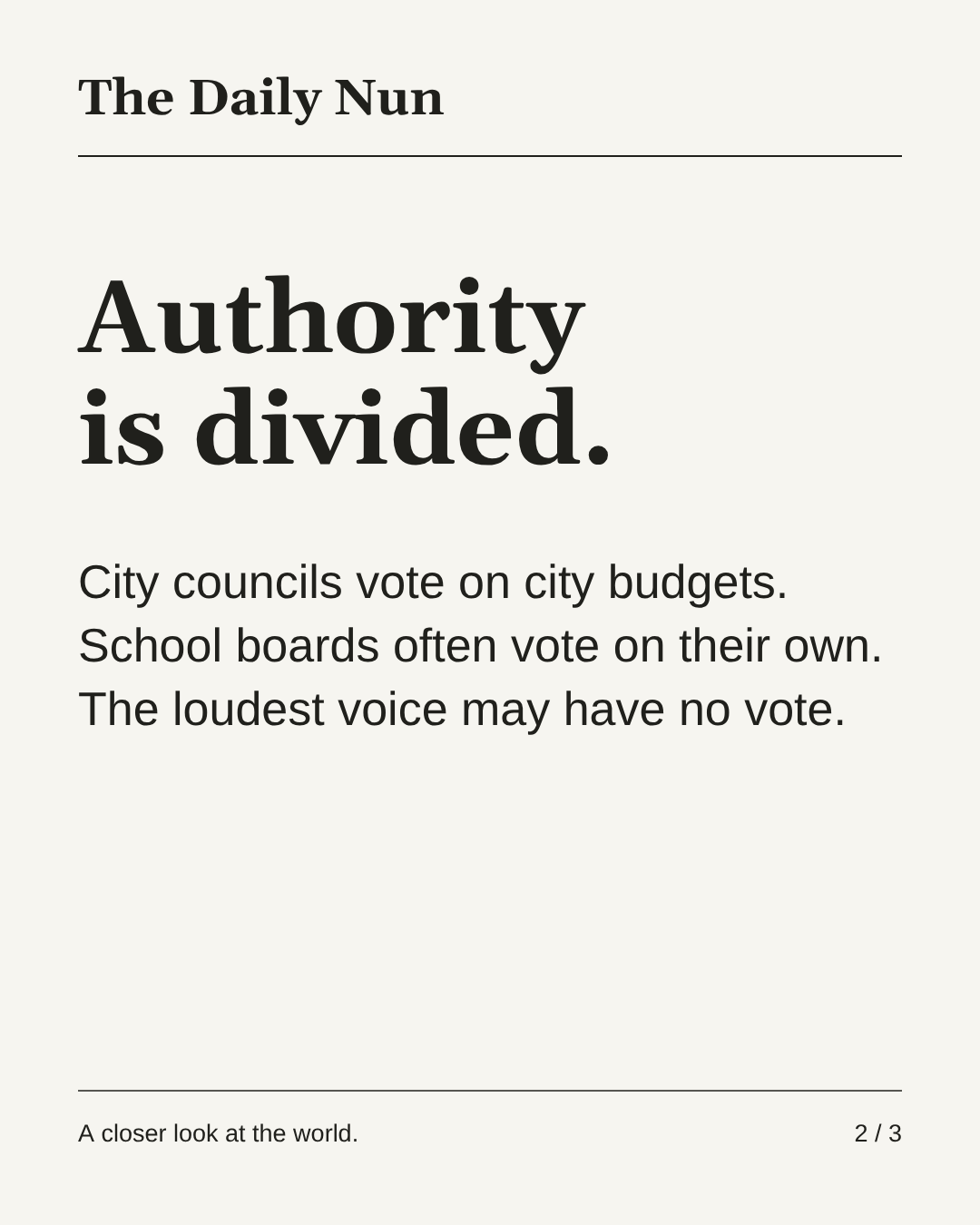
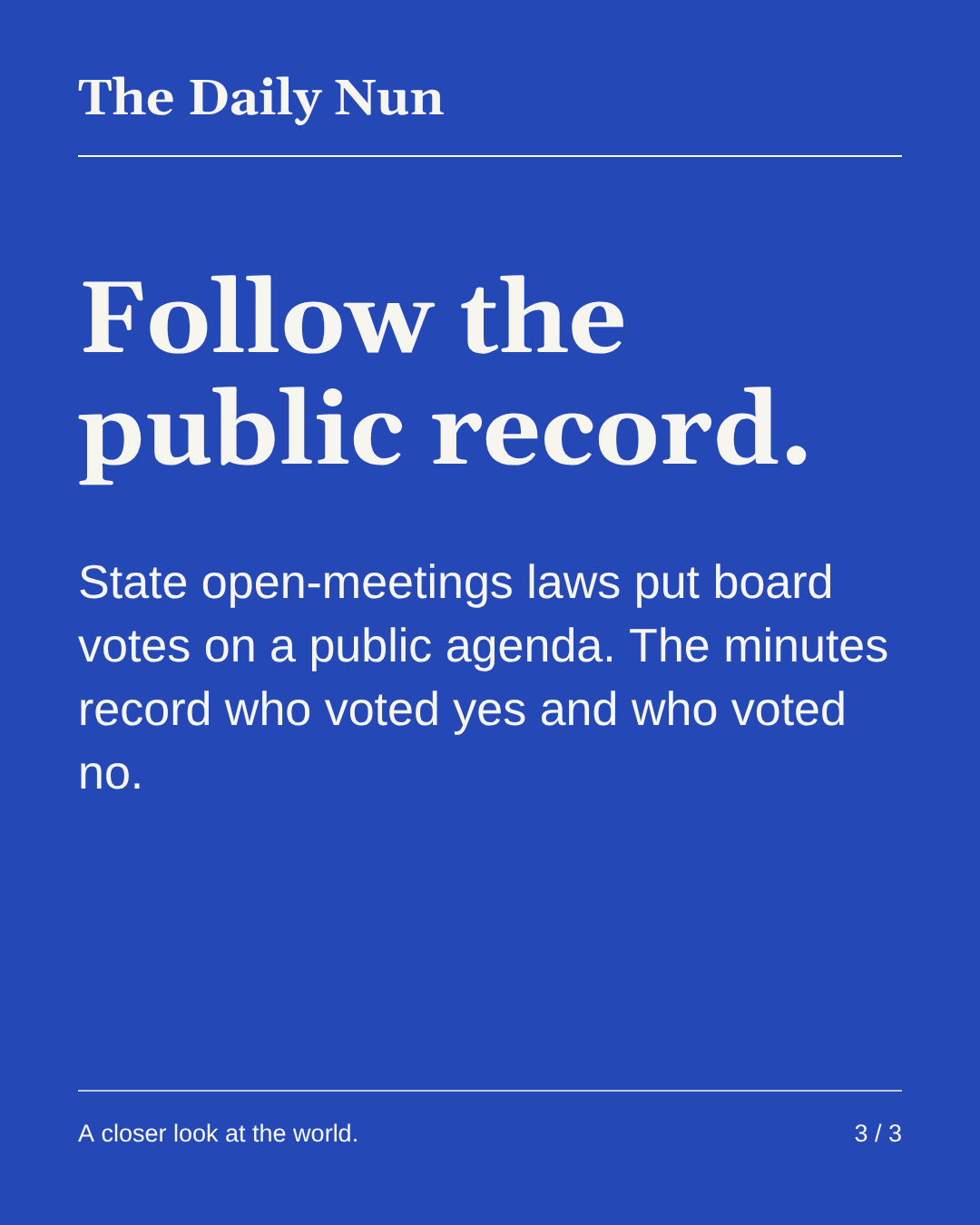
"Angry about a local decision? Don't tag the mayor. Power is divided. Councils vote on city budgets. School boards often run separately. Find the agenda. Read the minutes. They name who voted. The Daily Nun."
On-screen kinetic text sequence
- Angry about a local decision?
- Don't just tag the mayor.
- Councils vote on city budgets.
- School boards often vote separately.
- Board votes go on a public agenda.
- The minutes name who voted.
- The Daily Nun / A closer look at the world.
When does a recommendation become manipulation?
Instagram carousel preview (1080 × 1350)
Verified source ledger
-
Online Manipulation: Hidden Influences in a Digital World
Daniel Susser, Beate Roessler, Helen Nissenbaum (Georgetown Law Technology Review, 4 Geo. L. Tech. Rev. 1) — January 2020 (volume dated 2019)
Limits: One scholarly definition among several. The authors note that not everyone agrees hiddenness is required for manipulation. Definition passages read from the published PDF on 2026-11-13. -
How TikTok recommends videos #ForYou
TikTok (TikTok Newsroom) — June 18, 2020
Limits: The company's own description from 2020. It is not independently audited and may not describe the current system. -
Instagram Ranking Explained
Adam Mosseri (Instagram) — May 31, 2023
Limits: The company's own description from 2023. It lists signals and predictions but not their weights, and it is not independently audited. -
On YouTube's recommendation system
Cristos Goodrow (YouTube Official Blog) — September 15, 2021
Limits: The company's own description from 2021. It says recommendations drive 'a significant amount' of viewership and gives no figure. -
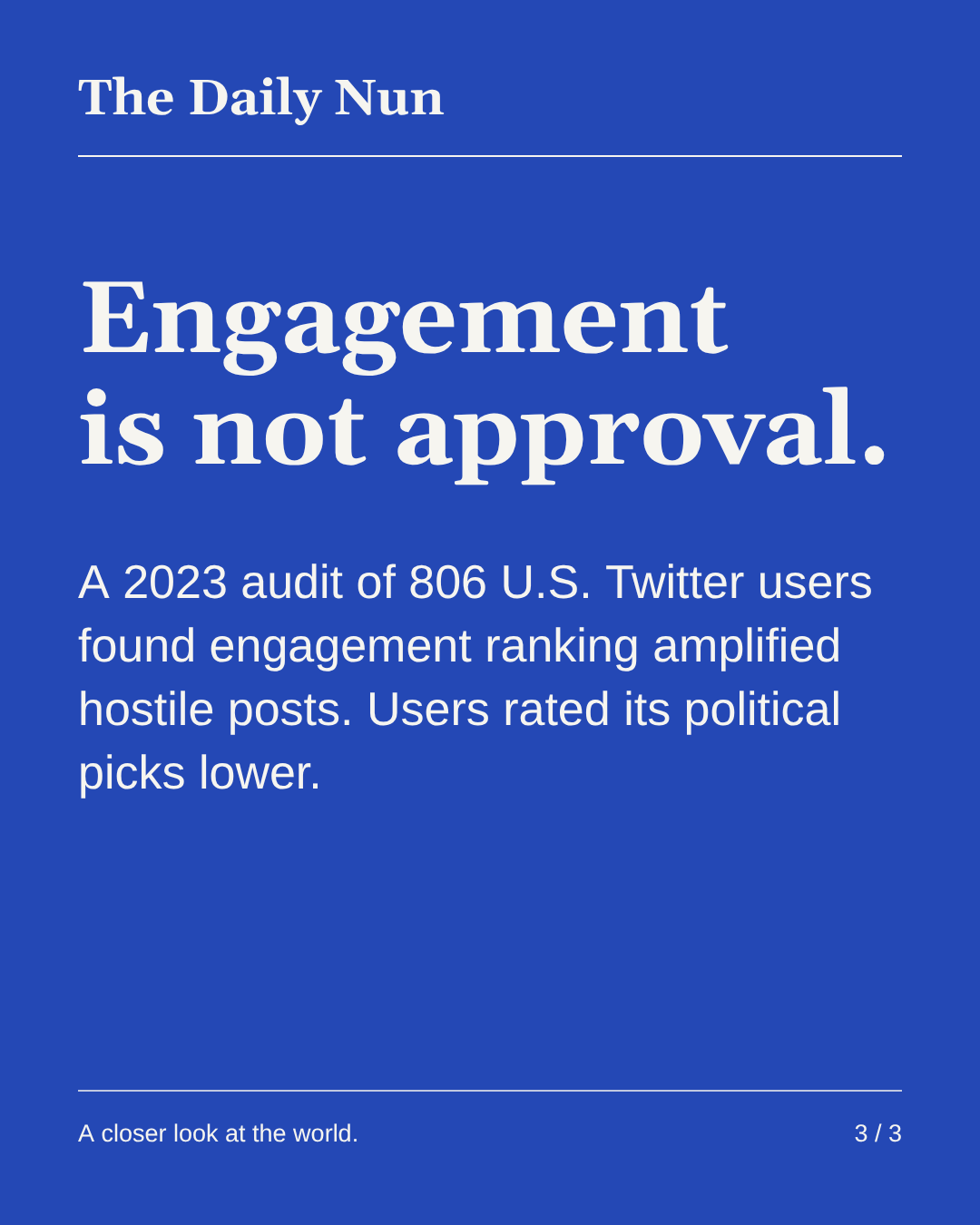
Engagement, user satisfaction, and the amplification of divisive content on social media
Smitha Milli, Micah Carroll, Yike Wang, et al. (PNAS Nexus 4(3), pgaf062) — March 5, 2025
Limits: 806 U.S. Twitter users recruited through a crowd-work platform, February 11-27, 2023. Sample skewed younger and more Democratic. One platform at one point in time; no long-term effects measured; only the first 10 tweets per timeline were surveyed. -
How do social media feed algorithms affect attitudes and behavior in an election campaign?
Andrew M. Guess, et al. (Science) — July 27, 2023
Limits: Abstract only, verified through Europe PMC for the repository's media-democracy report (source E01); the publisher page returned HTTP 403 on 2026-11-13. Consenting Facebook and Instagram users over three months in 2020; not an estimate of all accumulated platform effects. -
A Look Behind the Screens: Examining the Data Practices of Social Media and Video Streaming Services (press release)
Federal Trade Commission staff (Federal Trade Commission) — September 19, 2024
Limits: Based on orders issued in December 2020 to nine companies. Concerns data practices, not the effects of ranking on beliefs or purchases. -
For shopping, phones are common and influencers have become a factor – especially for young adults
Michelle Faverio and Monica Anderson (Pew Research Center) — November 21, 2022
Limits: 6,034 U.S. adults, July 5-17, 2022. Denominator for the purchase figures is adult social media users. Self-reported; does not establish that posts caused purchases. No respondents under 18. -
Psychological targeting as an effective approach to digital mass persuasion
Sandra C. Matz, Michal Kosinski, Gideon Nave, David J. Stillwell (Proceedings of the National Academy of Sciences) — November 13, 2017
Limits: Abstract only, read through Europe PMC on 2026-11-13. Three experiments reaching over 3.5 million people. 'Up to' figures are best cases, not averages. Tests tailored ads, not feed ranking. -
America's News Influencers
Pew Research Center (Pew Research Center) — November 18, 2024
Limits: 10,658 U.S. adults, July 15-August 4, 2024. Measures where people say they regularly get news, not whether it changed their views. No respondents under 18. -
The small effects of political advertising are small regardless of context, message, sender, or receiver: Evidence from 59 real-time randomized experiments
Alexander Coppock, Seth J. Hill, Lynn Vavreck (Science Advances) — September 2, 2020
Limits: Abstract only, read through Europe PMC on 2026-11-13. 49 ads, 59 experiments, 34,000 people, 2016 U.S. presidential campaign. Survey experiments on ad exposure, not feed ranking. -
A 2 million-person, campaign-wide field experiment shows how digital advertising affects voter turnout
Minali Aggarwal, Jennifer Allen, Alexander Coppock, et al. (Nature Human Behaviour) — January 12, 2023
Limits: Abstract only, read through Europe PMC on 2026-11-13. 2 million voters in five battleground states, 2020. Measures turnout, not trust. One partisan ad program. -
The effects of Facebook and Instagram on the 2020 election: A deactivation experiment
Hunt Allcott, Matthew Gentzkow, Winter Mason, et al. (Proceedings of the National Academy of Sciences) — May 13, 2024
Limits: Abstract only, read through Europe PMC on 2026-11-13. A randomized subset of 19,857 Facebook and 15,585 Instagram users deactivated for six weeks before the 2020 election. Tests access to the platforms, not the ranking system alone. -
Out-group animosity drives engagement on social media
Steve Rathje, Jay J. Van Bavel, Sander van der Linden (Proceedings of the National Academy of Sciences) — June 2021
Limits: Abstract only, read through Europe PMC on 2026-11-13 (also source M03 in the media-democracy report). 2,730,215 posts from news media and U.S. congressional accounts on Facebook and Twitter. Associations between wording and shares; does not show that posts made readers angrier or generated profit.
Instagram caption
Third-person institutional voice. Prepared draft; not posted.
Short video & voiceover teleprompter
Silent vertical Reel (~30 sec) alongside synchronized voiceover script.
Voiceover text to record
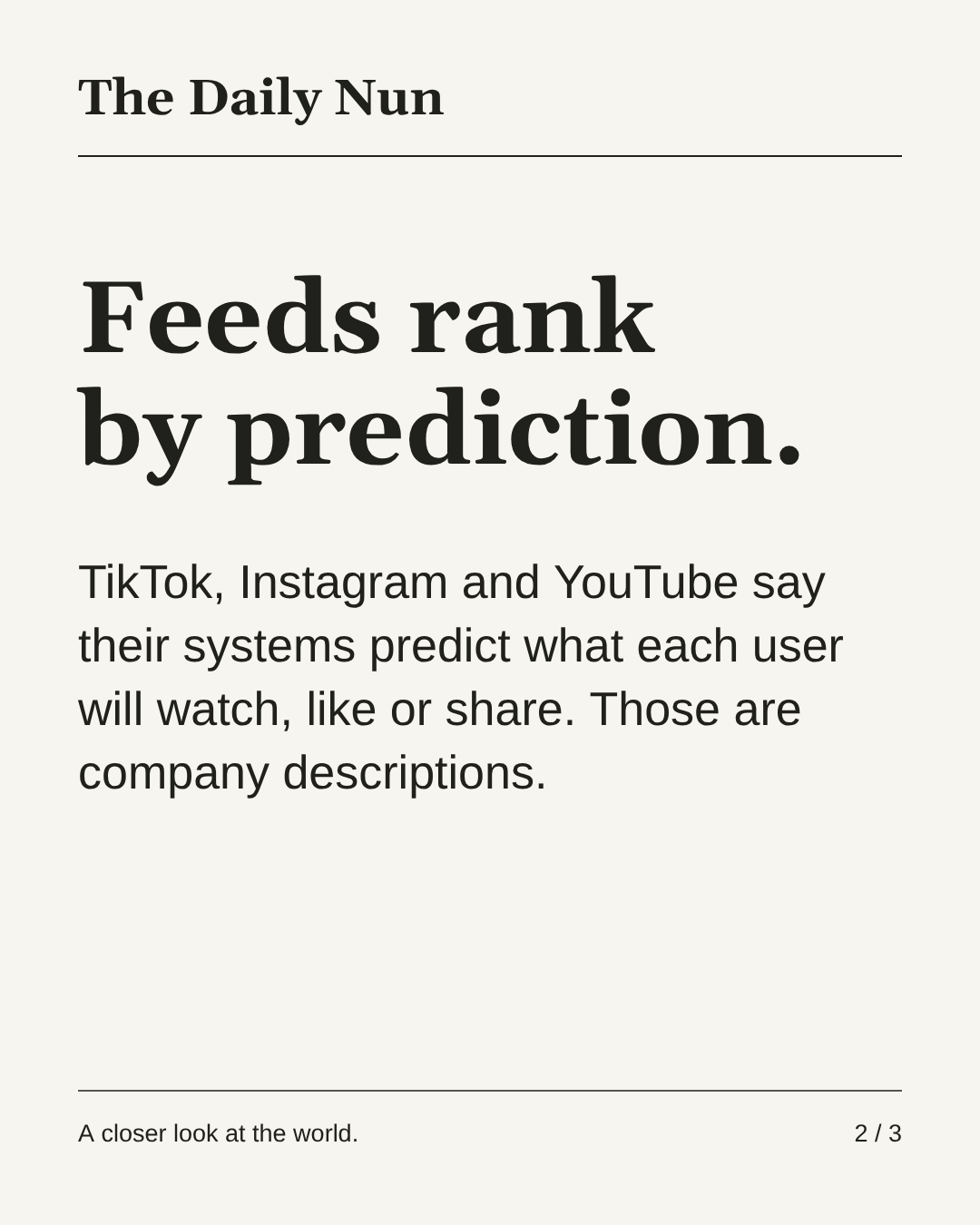
"Every feed is a ranking. TikTok, Instagram and YouTube say their systems predict what each person will watch, like or share. In 2023, researchers audited 806 U.S. Twitter users. Ranking by engagement showed them more angry, hostile posts than a newest-first feed, and they rated its political picks lower. One study is not the whole story. But a click is not the same as wanting more. The Daily Nun."
On-screen kinetic text sequence
- Who chose that video?
- A feed is a ranking.
- Platforms say they predict what gets watched, liked, shared.
- 2023: researchers audited 806 U.S. Twitter users.
- Engagement ranking showed more angry, hostile posts.
- Users rated its political picks lower.
- One study. Not the whole story.
- A click is not approval.
- The Daily Nun / A closer look at the world.
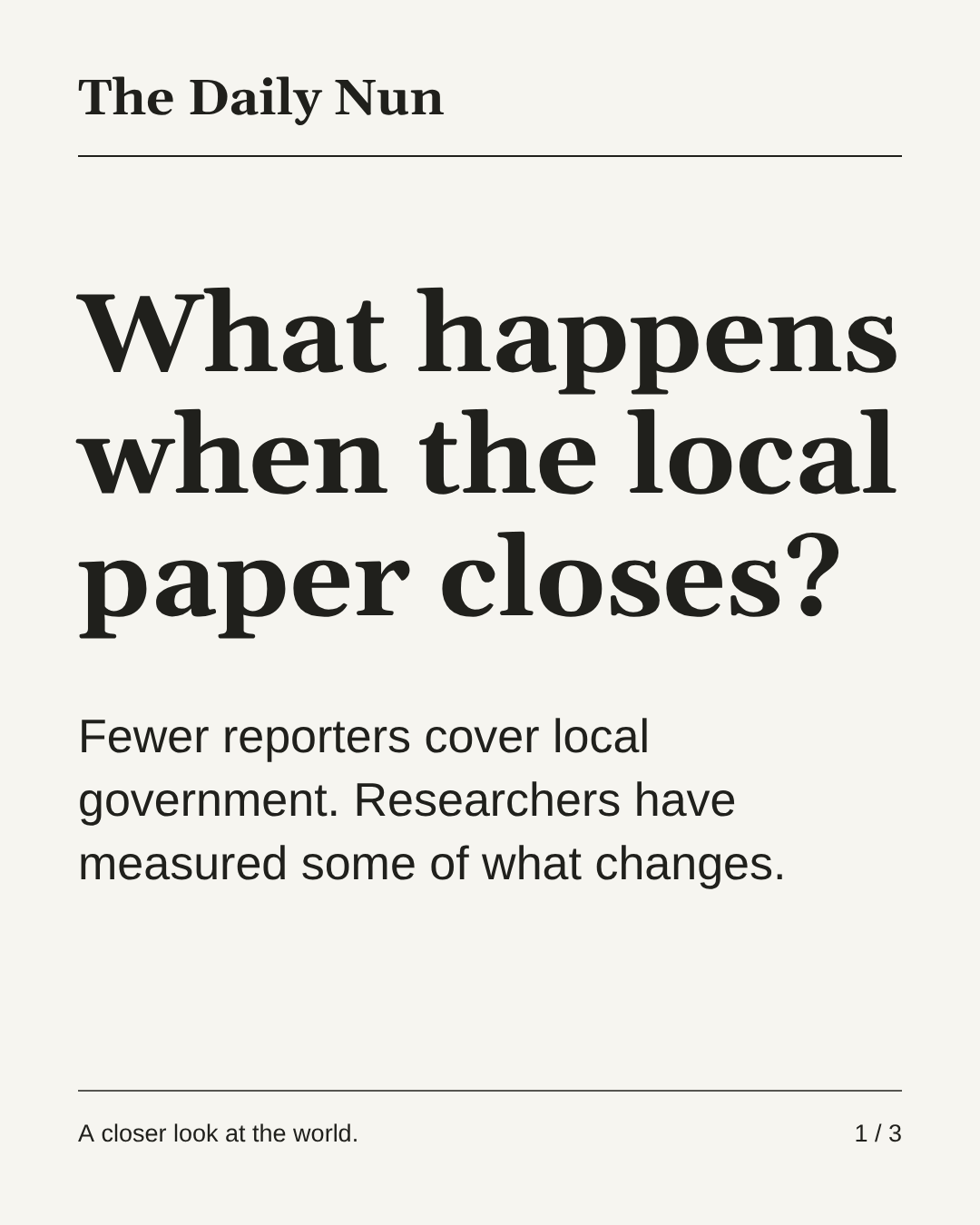
What happens when the local paper closes?
Instagram carousel preview (1080 × 1350)

Verified source ledger
-
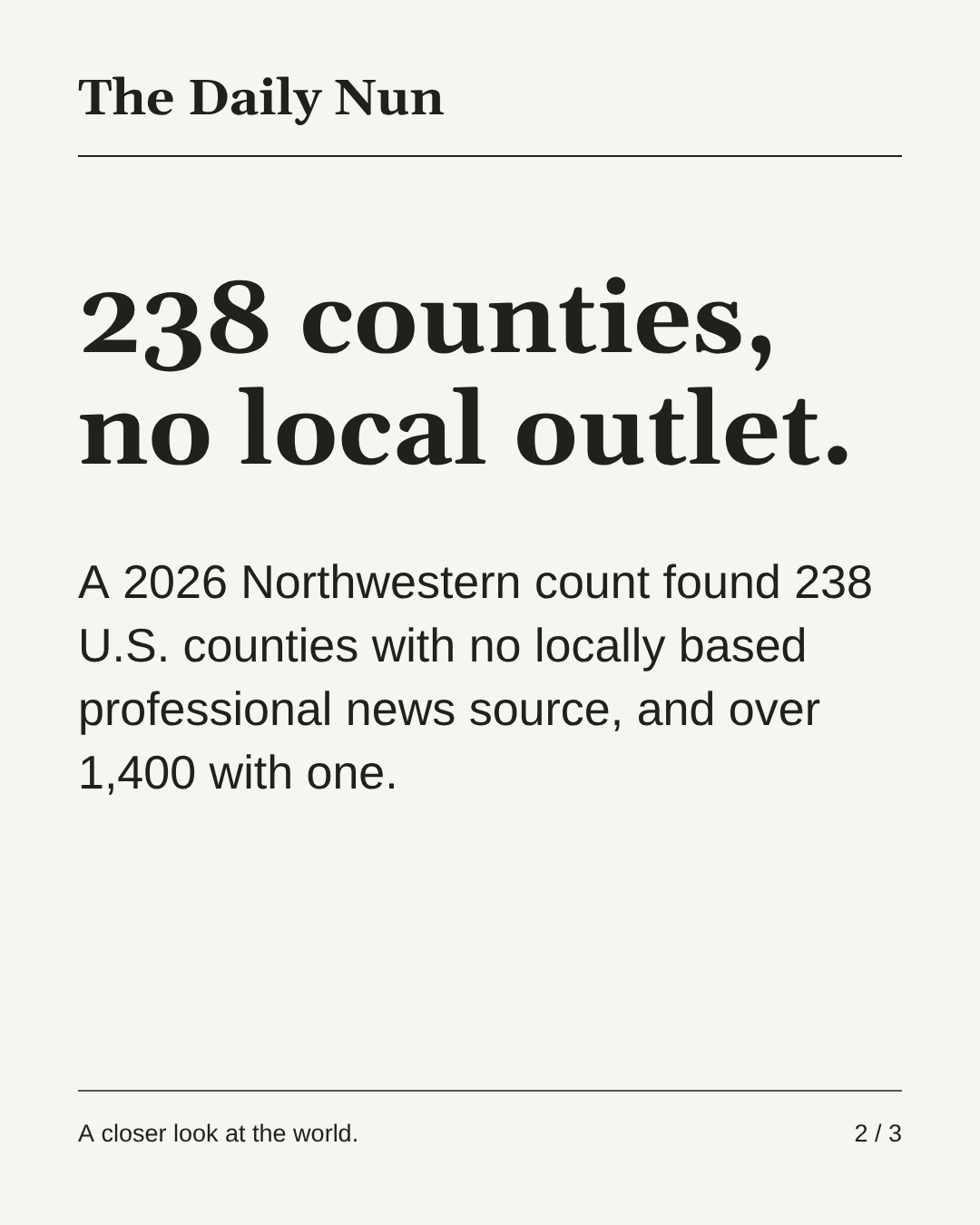
The State of Local News 2026
Zach Metzger and John Volk (Medill Local News Initiative, Northwestern University) — October 13, 2026
Limits: Counts locally based professional outlets, not every information source. The 170 figure combines closures and mergers. Methodology changed this year. Figures from the repository's report verification of 2026-11-11 (source E08); the site returned HTTP 503 and a certificate error on 2026-11-15. -
Financing dies in darkness? The impact of newspaper closures on public finance
Pengjie Gao, Chang Lee, Dermot Murphy (Journal of Financial Economics 135(2), 445-467) — 2020
Limits: Publisher abstract read on RePEc on 2026-11-15; full data, sample period, and methods not reviewed. The 5-11 basis point and $650,000 figures and the causal claim are the authors' own. -
Press Coverage and Political Accountability
James M. Snyder Jr., David Strömberg (NBER Working Paper 13878; Journal of Political Economy (2010)) — March 2008
Limits: Abstract read on 2026-11-15. Concerns U.S. House coverage in earlier decades, not newspaper closures directly. -
Local News and National Politics
Gregory J. Martin, Joshua McCrain (American Political Science Review) — February 19, 2019
Limits: Abstract read through Crossref on 2026-11-15. Concerns one conglomerate's acquisitions of local TV stations; results are relative to other programs in the same markets.
Instagram caption
Third-person institutional voice. Prepared draft; not posted.
Short video & voiceover teleprompter
Silent vertical Reel (~30 sec) alongside synchronized voiceover script.
Voiceover text to record
"What happens when the local paper closes? A 2026 Northwestern count found 238 U.S. counties with no locally based professional news source. One study estimated that after a local paper closed, the town's borrowing costs went up, about six hundred fifty thousand dollars per bond issue. Another found voters with less coverage were less likely to know their representative's name. The meeting still happens. Who is watching? The Daily Nun."
On-screen kinetic text sequence
- What happens when the local paper closes?
- 238 counties: no local news source.
- After closures, borrowing costs rose.
- About $650,000 per bond issue.
- Less coverage, less-known representatives.
- The meeting still happens.
- Who is watching?
- The Daily Nun / A closer look at the world.
Who decides who gets the hours?
Instagram carousel preview (1080 × 1350)
Verified source ledger
-
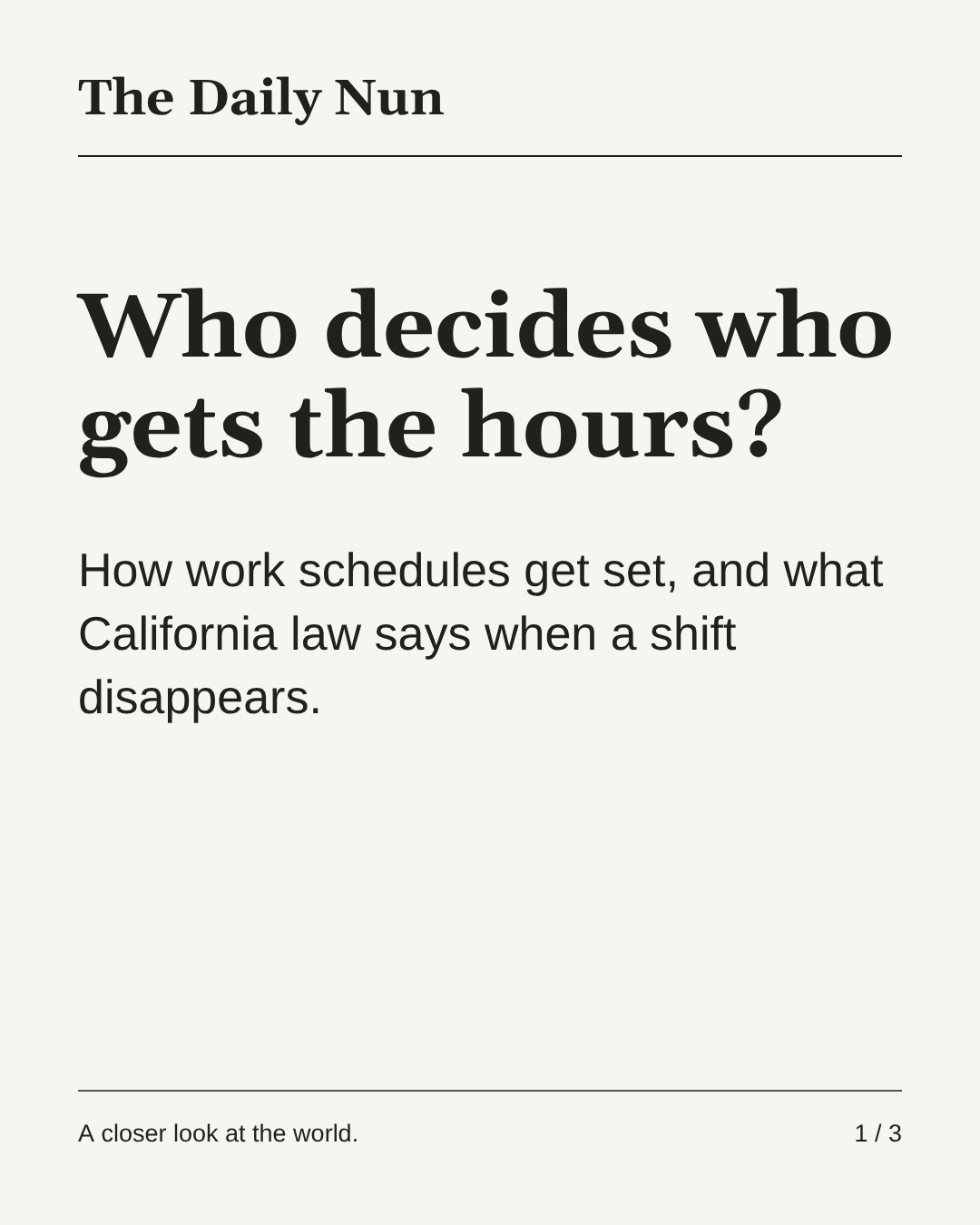
It's About Time: How Work Schedule Instability Matters for Workers, Families, and Racial Inequality
Daniel Schneider and Kristen Harknett (The Shift Project, Harvard Kennedy School) — October 16, 2019
Limits: About 30,000 employees at 120 of the largest U.S. retail and food-service firms; very large employers only; the brief does not break out high-school or student workers, and small businesses are not covered. Hardship findings are associations, not proof that schedules caused them. Read in full on 2026-11-15. -
Reporting time pay: frequently asked questions
California Labor Commissioner's Office (DLSE) (California Department of Industrial Relations) — Undated web page, read 2026-11-15
Limits: Guidance, not the regulation itself (IWC wage orders, section 5). Has exceptions: threats, utility failures, acts of God, paid standby, shifts under two hours, and workers who leave on their own. -
Complying With Child Labor Laws: Information for Employers
California Labor Commissioner's Office (DLSE) (California Department of Industrial Relations) — April 2026 (PDF creation date)
Limits: Summary for employers. Exceptions exist, such as school-approved work experience programs. The statute (Labor Code section 1391) was not opened; the legislature's site blocked automated access. -
Fair Work Week Information
City of Los Angeles, Office of Wage Standards (City of Los Angeles) — Ordinance effective April 1, 2023; page read 2026-11-15
Limits: Applies only to retail employers with 300 or more employees globally, for work inside the City of Los Angeles. Other cities' rules were not checked. -
Newsom Signs McNerney's No Robo Bosses Act of 2026 Requiring Human Oversight of AI in the Workplace
Office of Sen. Jerry McNerney (California State Senate) — September 30, 2026
Limits: The author's own announcement of SB 947. The governor's page and the bill text could not be opened (blocked to automated access). -
California enacts SB 947: What employers need to know about the "No Robo Bosses Act"
DLA Piper (DLA Piper) — October 2026
Limits: Secondary legal summary, used only for the law's scope (discipline and firing) and effective date (July 1, 2027).
Instagram caption
Third-person institutional voice. Prepared draft; not posted.
Short video & voiceover teleprompter
Silent vertical Reel (~30 sec) alongside synchronized voiceover script.
Voiceover text to record
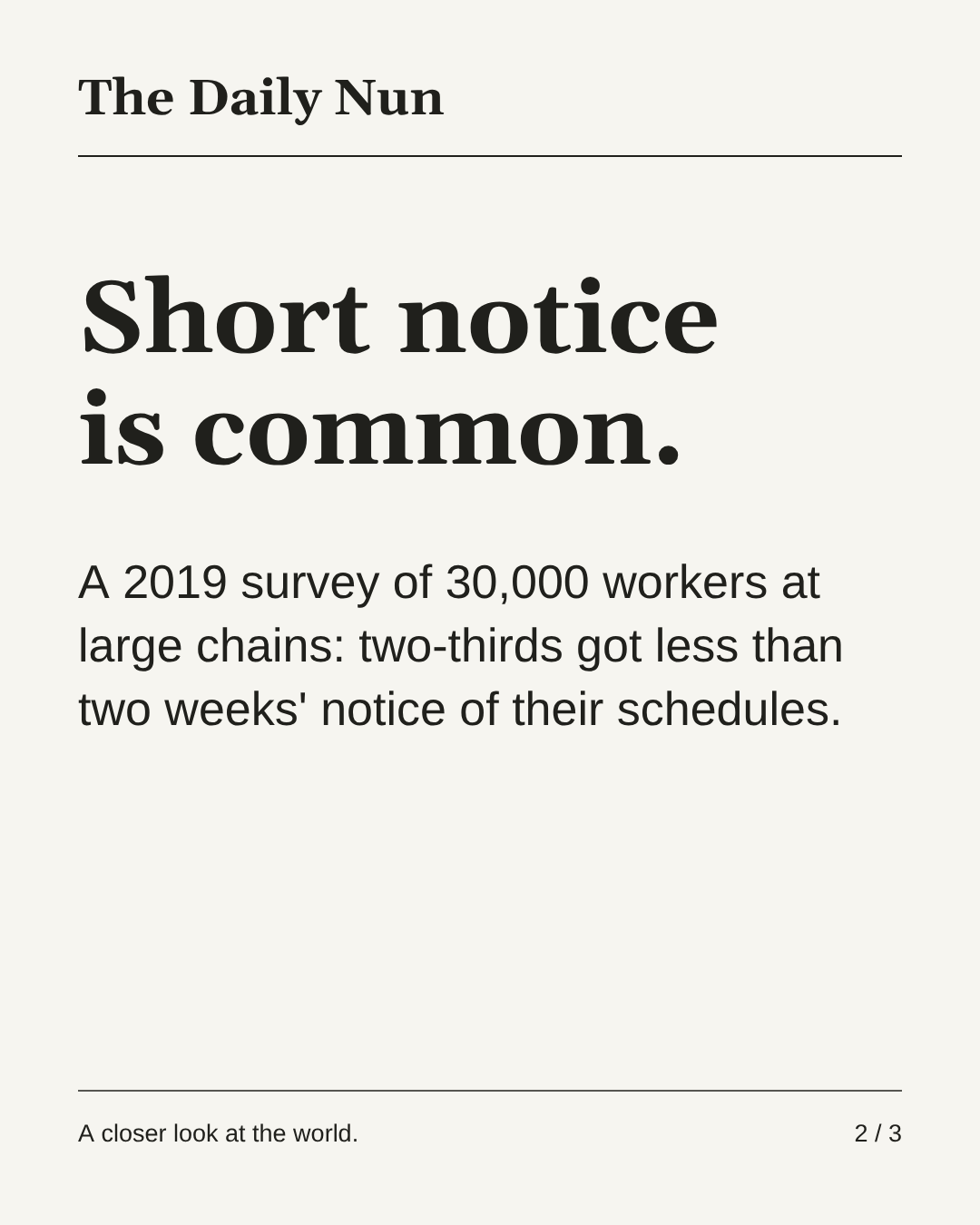
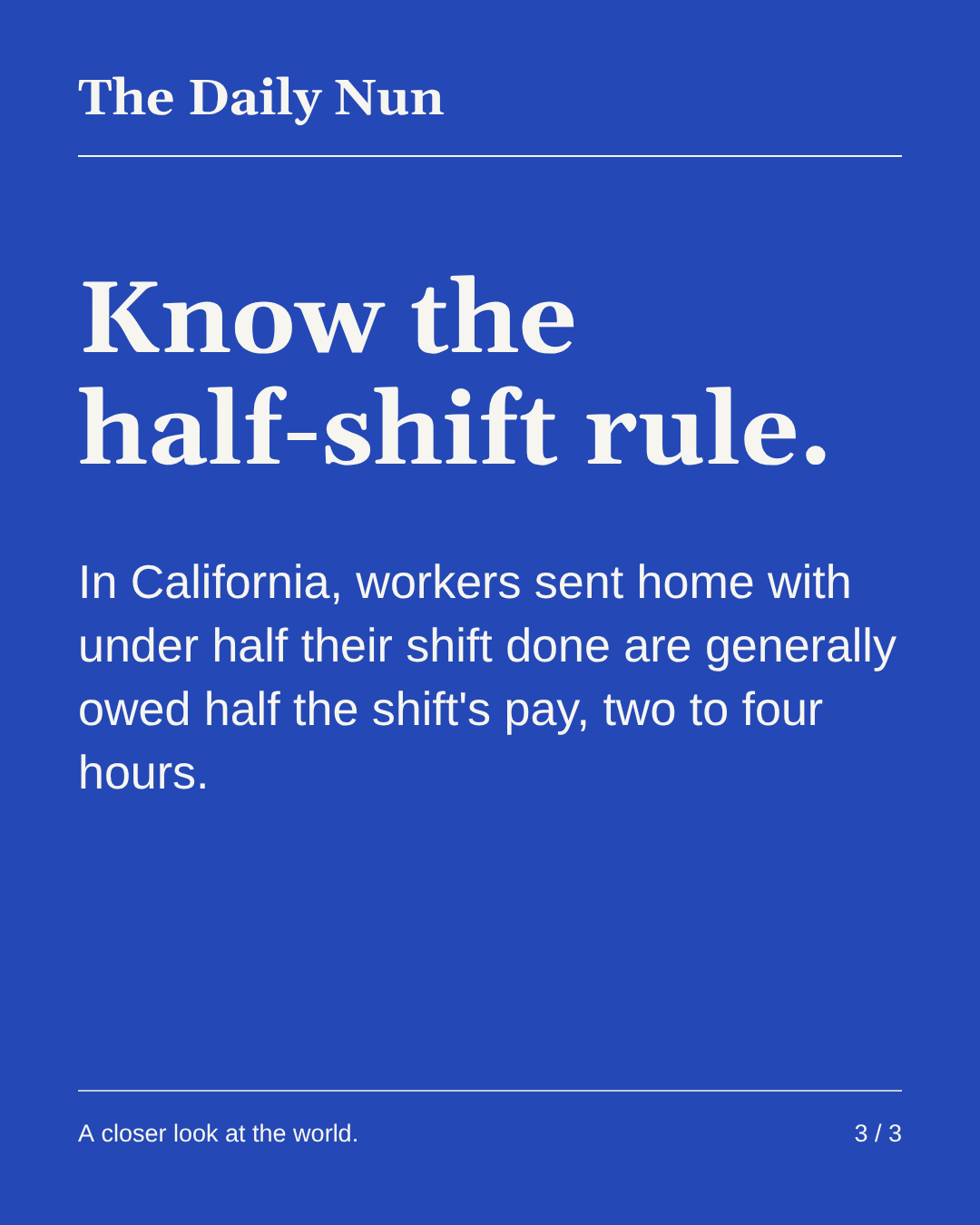
"Who decides who gets the hours? The employer does. A 2019 survey of thirty thousand workers at big chains found two in three got less than two weeks' notice. California sets a few limits. Sent home with under half a shift done? The worker is generally owed half the shift's pay. Under eighteen? Four hours, max, on a school day. The Daily Nun."
On-screen kinetic text sequence
- Who decides who gets the hours?
- The employer does.
- 2019: 30,000 workers at big chains surveyed.
- Two in three: under two weeks' notice.
- California sets a few limits.
- Sent home early? Some pay is owed.
- Under 18? Four hours on school days.
- The Daily Nun / A closer look at the world.
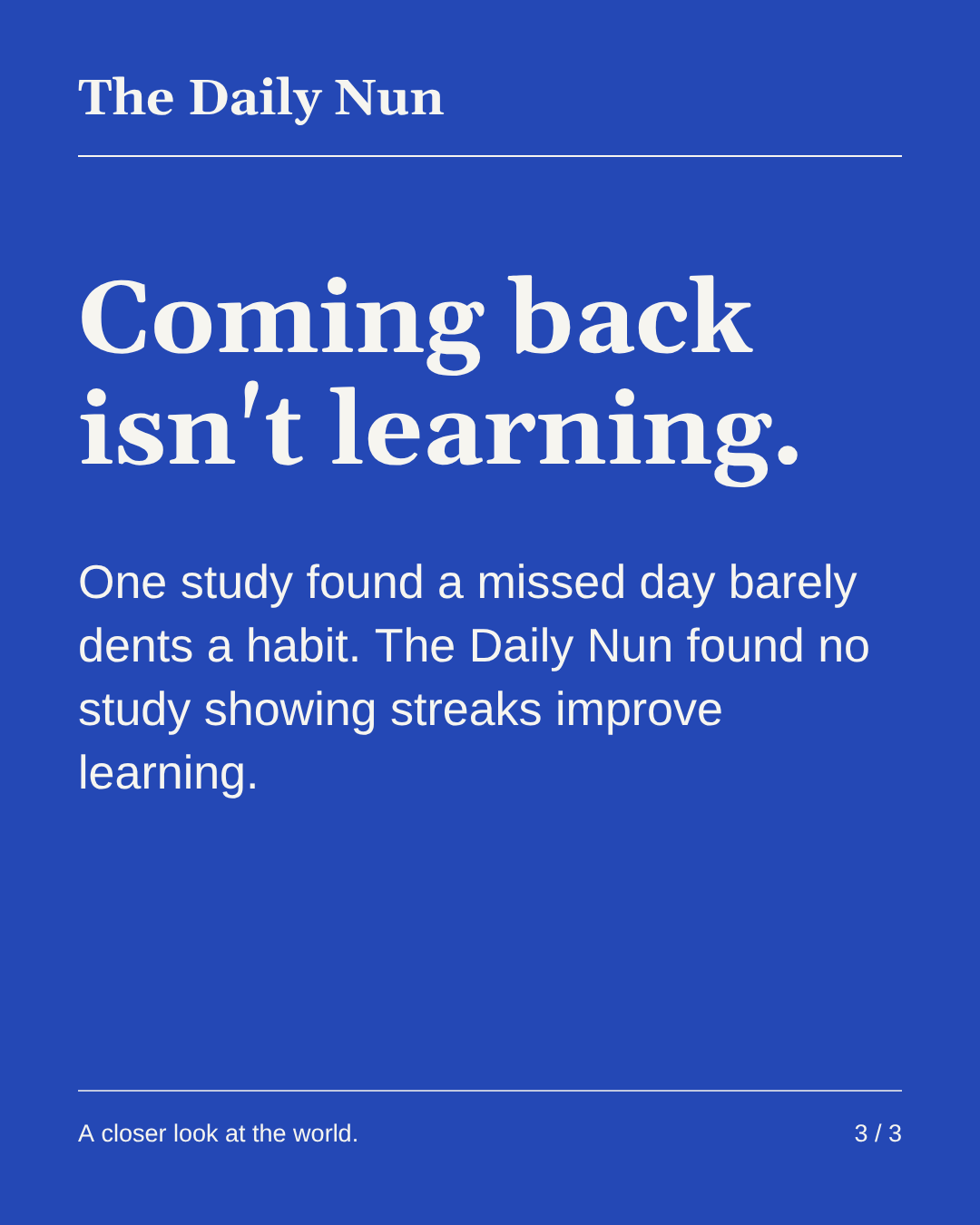
Does a streak help anyone learn?
Instagram carousel preview (1080 × 1350)
Verified source ledger
-
The Duolingo Streak Uses Habit Research to Keep You Motivated
Osman Mansur (Duolingo Blog) — January 31, 2022
Limits: The company describing its own design and reporting its own A/B test results (+1.7% seven-day retention from milestone animations; +0.38% relative daily active learners from two streak freezes). Not independently verified. Read in full on 2026-11-15. -
Improving the streak: Forming habits one lesson at a time
Anton Yu (Duolingo Blog) — November 19, 2020
Limits: Company-reported result (over 40% more learners on a 7+ day streak after decoupling streaks from daily goals). Measures streak counts, not learning. Not independently verified. -
How are habits formed: Modelling habit formation in the real world
Phillippa Lally, Cornelia H. M. van Jaarsveld, Henry W. W. Potts, Jane Wardle (European Journal of Social Psychology 40(6), 998-1009) — Published online July 16, 2009 (print October 2010)
Limits: Abstract only, read through Crossref on 2026-11-15. 96 volunteers, 82 analyzed, 39 with good model fit; small sample. Studied eating, drinking, or exercise habits, not app streaks or learning. -
On or Off Track: How (Broken) Streaks Affect Consumer Decisions
Jackie Silverman, Alixandra Barasch (Journal of Consumer Research 49(6), 1095-1117) — April 2023
Limits: Abstract only, read on the University of Colorado's publication page on 2026-11-15. Measures subsequent engagement, not learning outcomes. Effect sizes and samples not read.
Instagram caption
Third-person institutional voice. Prepared draft; not posted.
Short video & voiceover teleprompter
Silent vertical Reel (~30 sec) alongside synchronized voiceover script.
Voiceover text to record
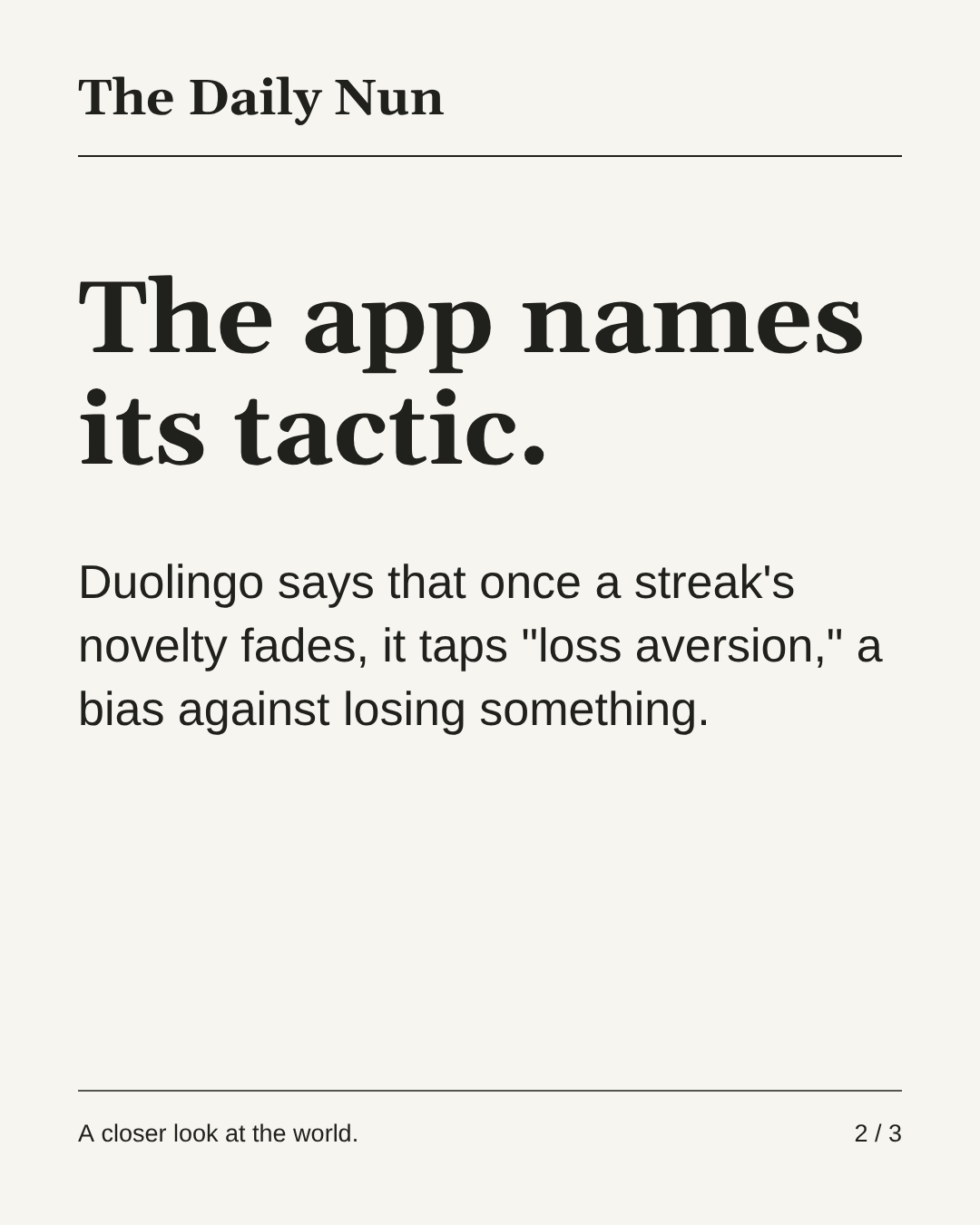
"Does a streak help anyone learn? Duolingo says that once a streak stops feeling new, it taps loss aversion: a bias against losing something. Research says a missed day barely affects a habit. But seeing a streak reset can lead people to do less. What no study found here shows is that streaks help anyone learn more. Counting days is not the same as learning. The Daily Nun."
On-screen kinetic text sequence
- Does a streak help anyone learn?
- Duolingo: the streak taps "loss aversion."
- A missed day barely affects a habit.
- Seeing a reset can lead to less.
- No study found here shows more learning.
- Counting days is not learning.
- The Daily Nun / A closer look at the world.